Artificial intelligence is no longer a speculative concept for government agencies. It is an operational reality. Yet for community development, permitting, and land management organizations, adoption has been cautious, and for good reason. These agencies operate in highly regulated environments where transparency, auditability, and consistency are not optional, they are foundational.
That tension is reflected in a key finding from Ernst & Young: a 2025 survey found that 78% of municipal IT decision-makers are concerned about the lack of clear regulations and standards for AI development. This is not resistance to innovation. It is a rational response to risk.
At the same time, agencies are under mounting pressure to address backlogs, accelerate approvals, and improve service delivery without expanding staff. The result is a clear mandate: adopt AI, but do so safely, incrementally, and within well-defined governance frameworks.
This is where the conversation shifts from theoretical AI transformation to practical, immediate-use cases, the kind that deliver measurable value without introducing systemic risk.
One of the most persistent challenges in community development is the electronic plan review process. Despite digitization efforts, many agencies still face:
A significant portion of plan review delays stems from preventable submission errors. Incomplete or non-compliant applications enter the system, only to be flagged later by reviewers, creating inefficiencies that ripple across the entire workflow.
This is precisely where AI can deliver one of its most immediate and impactful wins.
Rather than attempting to replace human reviewers, modern AI solutions are being deployed upstream, at the point of submission. These tools:
The result is a fundamental shift: from reactive review to proactive validation.
This approach aligns perfectly with the risk posture of government agencies. It does not remove human oversight; it enhances it. It does not introduce opaque decision-making; it standardizes and documents it.
Computronix’s partnership with Archistar illustrates how AI-assisted analysis can complement established municipal permitting workflows.
POSSE PLS provides the enterprise platform for managing applications, coordinating reviews, tracking progress, and supporting municipal decision-making. Archistar AI PreCheck adds a specialized capability for analyzing configured plans and supporting documents to identify missing information and selected compliance concerns.
Depending on the jurisdiction’s requirements and implementation scope, AI-assisted pre-checking can support several approaches:
Staff-assisted review: Municipal staff access preliminary findings during application intake or review.
Applicant feedback: Applicants receive earlier information about identified submission issues.
Pre-submission checking: Selected requirements are evaluated before an application enters formal review.
These approaches can help agencies explore opportunities to improve submission quality and reduce avoidable correction cycles. However, the appropriate configuration, available checks, and integration requirements must be established for each jurisdiction.
Importantly, AI PreCheck does not independently approve or deny building permits. Professional reviewers retain responsibility for regulatory interpretation, exceptions, and formal decisions.
Learn more about AI Permit PreCheck and its implementation options.
For government technology leaders, the value proposition is clear:
In other words, this is not AI as a disruptive force. It is AI as a compliance accelerator.
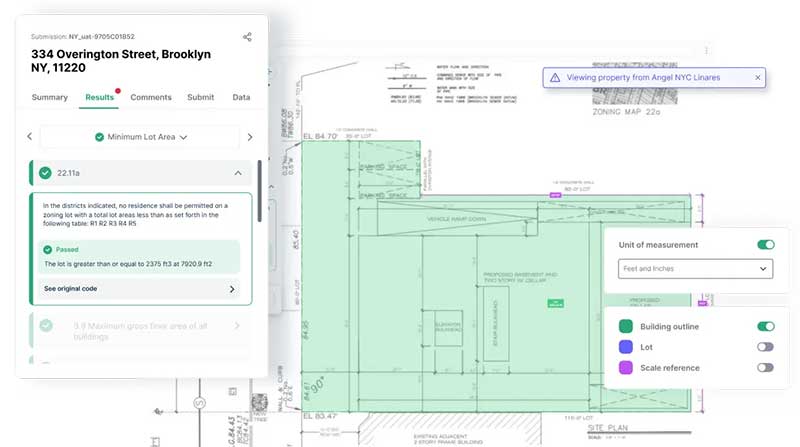
Archistar AI PreCheck analyzes configured submission materials to identify potential completeness and selected compliance issues. Findings support earlier clarification and professional review; they do not constitute municipal approval.
The hesitation identified in the Ernst & Young survey centers on governance: unclear standards, lack of oversight, and potential risk exposure.
Solutions like AI PreCheck directly respond to these concerns by design:
This creates a deployment model that aligns with public sector expectations: structured, explainable, and policy-driven AI.
While plan review represents a high-impact internal workflow, there is an equally pressing challenge on the external side: citizen engagement and information access.
Community development departments field thousands of inquiries related to:
These interactions are often repetitive, time-consuming, and resource-intensive. More importantly, they create friction for citizens who are trying to comply with complex regulations.
Generic AI chatbots have raised legitimate concerns in government contexts, particularly around:
According to Gartner, enterprise AI deployments must prioritize trusted data environments and governance controls to be viable in regulated industries.
This is where POSSE Assistant differentiates itself.
Unlike public-facing AI tools that draw from broad internet sources, POSSE Assistant is designed to operate within a controlled information ecosystem. It leverages:
This ensures that responses are:
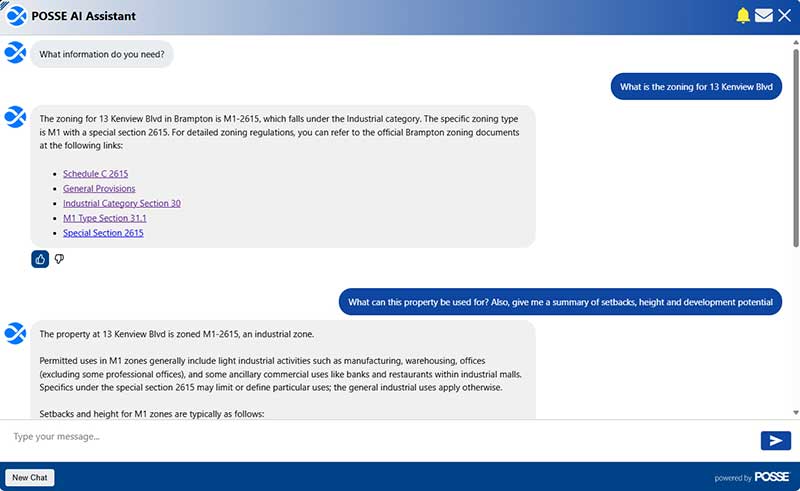
POSSE Assistant provides tailored answers to user questions using a curated set of data sources including GIS layers, zoning data, application status records, and government knowledge bases.
For government leaders, POSSE Assistant delivers another set of immediate, low-risk wins:
What makes these two capabilities, AI PreCheck and POSSE Assistant, particularly powerful is how they reinforce each other within the broader workflow.
Together, they create a closed-loop system that addresses inefficiencies at both ends of the process:
This is not a futuristic vision. It is an immediately deployable model for incremental AI adoption.
For agencies evaluating AI, the research is clear: success does not come from sweeping transformation initiatives. It comes from targeted, high-impact use cases that align with existing workflows and governance models.
The most viable AI deployments in community development share several characteristics:
Both AI PreCheck and POSSE Assistant exemplify this approach.
The concerns highlighted by the Ernst & Young survey is unlikely to disappear overnight. Nor should it. Government agencies have a responsibility to approach AI with rigor and discipline.
However, the emergence of practical, governance-aligned AI solutions changes the equation.
Instead of asking, “Should we adopt AI?” agencies can now ask:
For community development and land management agencies, the answers increasingly point to AI at intake and AI at the point of engagement.
AI adoption in government does not need to begin with risk. It can begin with results.
By focusing on:
agencies can achieve measurable improvements in efficiency, service delivery, and compliance—while maintaining full control over how AI is deployed and governed.
For technology leaders, this represents a rare alignment: solutions that deliver immediate operational value while directly addressing the sector’s most pressing concerns around standards, transparency, and risk.
In a landscape defined by caution, these are the kinds of wins that build confidence, and ultimately momentum, for broader, more transformative innovation.